Showing posts with label lit. Show all posts

Thursday, June 16, 2022

Literature: The Fountain of Age


"Half old chicken" at Asian market. Toronto, Canada. June 2016. Credit: Mzuriana.


Betty Friedan is best known for The Feminine Mystique (1963), published when she was 42 years old.

Three decades later, at age 72, she birthed another pivotal book: The Fountain of Age. She proposed that we replace the view of aging as a process of decline with a view that aging "opens the way to a further dimension of 'personhood.'" 


p. 20

"In the months that followed my sixtieth birthday, I grimly forced myself to study age, head on. .... I took a fellowship at Harvard ... I would immerse myself in state-of-the-aging art: medical, clinical, physiological, psychological, social policy. .... 

"Looking around the paneled room at my first Harvard meeting on 'Ethical Issues in the Care of the Aged,' I realized that, aside from my own, there was only one white head of hair. It belonged to a man who was a pioneer in the study of age and was about to retire (it seemed gerontologists must also retire at age sixty-five). These bright young turks of the new aging field were mostly men who maybe started out in psychiatry, doing post-docs in 'geropsychiatry' ..., and a few women staking out new turf as legal-medical 'ethicists.'" ....


"I grimly forced myself to study age, head on ..." 

Well, I feel neither grim nor forced, but otherwise, I'm with Betty on an exploration of the Land of Age. 

It's my big new country of residence, after all, and I want to see what's what. 


Wednesday, January 26, 2022

Literature: Elderhood and Mary Ruefle on the Freedom of Age


Alamogordo Balloon Invitational. New Mexico. September 2013.

In her book, Elderhood, Louise Aronson quotes poet Mary Ruefle on the joys of becoming old: 

"You should never fear aging because you have absolutely no idea the absolute freedom in aging; it's astounding and mind-blowing. You no longer care what people think. As soon as you become invisible - which happens much more quickly to women than men - there is a freedom that's astounding. And all your authority figures drift away. Your parents die. And yes, of course, it's heartbreaking but it's also wonderfully freeing." 


Mary Ruefle is not all butterflies and birdsong about aging, of course. Getting to the sunny meadow, for many of us, requires a walk through a dark, Brothers Grimm forest. But once we make it through, she states in her 2015 essay, Pause, published in Granta: 

You are a woman, the ten years [in the dark forest] have passed, you love your children, you love your lover, but there are no longer any persons on earth who can stop you from being yourself, you have put your parents in the earth, you have buried the past. Of course in the meantime you have destroyed your life and it has to be completely remade and there is a great deal of grief and regret and nostalgia and all of that, but even so you are free, free to sit on the bank and throw stones and feel thankful for the few years or one or two decades left to you in which you can be yourself, even if a great many other women ended their lives, even if the reason they ended their lives is reported as having been for reasons having nothing to do with menopause, which is thankfully behind you as you would never want to be a girl again for any reason at all, you have discovered that being invisible is the biggest secret on earth, the most wondrous gift anyone could ever have given you.


Aronson nests her Ruefle quote in her larger essay on how happy, as a group,  the old are: 

"... Sixty- to sixty-four-year-olds were happier and more satisfied with their lives than people aged twenty to fifty-nine, but not nearly as happy as those aged sixty-five and over. Even those over age ninety were happier than the middle-aged." 

Page 255


The reason Aronson talks about the relative happiness of age is not as a reassurance to the younger demographics who fear aging. It's not an affirmation for legislators and policy makers who might like to congratulate themselves for jobs well done on behalf of their so-called Greatest Generation. 

No. It's the opposite. 

Aronson tells us about the relative happiness of the old in order to say: The quality of life - in spirit, mind, and body - for old people is worth a thoughtful, mission-based investment of our finite national resources of time, money, and holistic policies. 

Focusing on a quality-of-life mission will demand that healthcare providers think beyond their knee-jerk go-to's of drugs, invasive or expensive testing, and surgeries. 

It will demand that Big Pharma include a significant number of young-old, middle-old, and old-old people in its clinical trials. 

It will demand that Big Medicine educate itself on how to address the complexity of co-morbidities in the old, and to, at least, do no harm through laziness, contempt, or ignorance about, for instance, the way drugs behave in the elderly differently than they do in younger people. 


Monday, January 17, 2022

Literature: Elderhood: Louise Aronson and Ursula Le Guin


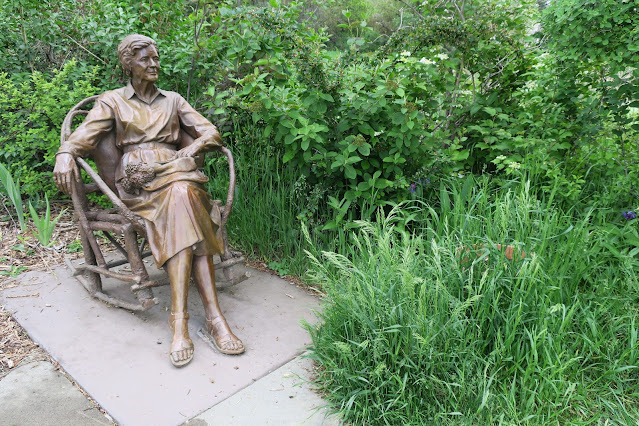
Older Woman, Benson Sculpture Garden, Colorado. May 2016

In Elderhood, author Louise Aronson draws on the salt of Ursula Le Guin: 

"There are sayings about aging that everyone likes, and others that people find reassuring when they are young or young-old, and preposterous as they grow older still. You're only as old as you think you are is one of them. 

"Ursula K. Le Guin rebutted this popular falsehood and several others with her usual wit and brilliance: 'If I'm ninety and believe I'm forty-five, I'm headed for a very bad time trying to get out of the bathtub.' 

"She goes on to note that [when people say You're only as old as you think you are to] 'somebody who actually is old, they don't realize how stupid it is, and how cruel it may be.' 

"Another expression I hear often .... is Old age isn't for sissies. Of that one, Le Guin had to say: 'Old age is for anybody who gets there. Warriors get old; sissies got old ... Old age is for the healthy, the strong, the tough, the intrepid, the sick, the weak, the cowardly, the incompetent.'

"She acknowledged that most people say such things with good intentions but equated telling her in her eighties that she wasn't old with telling the Pope he isn't Catholic. .... 'To tell me my old age doesn't exist is to tell me I don't exist.' 

"In old age, as in so many other parts of life, when our self-delusions are indulged, our reality and true selves, along with all our needs and opportunities, are erased." 

Page 141


I add another annoying bromide: Age is only a number. 

You see that on dating sites a lot. 

It makes me roll my eyes. 

I'm a woman of some age. I've clocked some numbers. I can still do a lot of shit. But there's some shit I probably can't - or don't want to - do like a thirty year-old. And there's some shit I couldn't or wouldn't do as a thirty year-old that I can do now.