Showing posts with label literature. Show all posts

Monday, March 27, 2023

Literature: Successful Aging, Part 1


Successful Aging by Daniel Levitin. Image source: Goodreads


A friend recommended Successful Aging, by Daniel J. Levitin, to me. Dr. Levitin is a neuroscientist. A neuropsychologist recommended the book to my friend, and she found the content illuminating. 

I've now finished the book, and here's my overall take: 

  1. Some useful information, both for general science education and also for some actionable behaviors one can practice to promote successful aging
  2. Dr. Levitin really drives home the difference between our life spans and our health spans. Embracing the term "health span" sharpens my focus for actions and decision-making into the future. 
  3. Too many of the "facts" that Dr. Levitin presents are anecdotal; they are stories of individuals who are in their 90s or older who are doing this or that magnificent thing. Stories of individuals are engaging, but I want data supported by empirical research. 
  4. There are specific strategies from the book that I intend to employ, which I'll get into as I process the book in future posts. 
  5. I wish there'd been more editing to reduce the information bloat; more specifically, my interest centered on how our bodies/brains age, but I had to wade through (and, eventually, skip over) so much background information on what our bodies/brains are like as infants, young children, and young adults. In other words, the introduction to every Important Idea was like an inverted pyramid, and the payoff for all that background context didn't feel like a good ROI of my finite resources of time and intellectual interest.  

If I had to score the book on a scale of 0 to 5, with 5 being exemplary, I'd give it a 3.75.  [Edit:... I'd give it a 4.5 ..... I upped my preliminary assessment after I revisited all of the highlighted text I'd marked while reading the book the first time. Also, the author has documented his intel to a faretheewell in his Notes section at the back of the book.] 


Thursday, August 25, 2022

Digital Journals: The Other Side of Sixty

Roasting coffee beans. Washington, D.C. May 2007. Credit: Mzuriana.
 

The Other Side of Sixty, by "Wisewebwoman."

The author lives in Newfoundland, Canada. I'll call her WBW (wise web woman). 

Age 79 (as of today's writing).

WBW is very open about how she moves through the sea of age. Some days are clear sailing, a goodly breeze. Some are stormy, treacherous. Some days the sail is still and flaccid, her vessel stalled over the deep unknowable.

WBW's blog is an espresso. Black, no sugar. Flavorful.

She has visited some corners of aging that I've touched on, as well, and I find sustenance in reading similar experiences. 


Monday, August 22, 2022

Digital Journals: The 80-Something Blog


Judy Kugel. Source: The Art of Applying.


Rather than craft an introduction, I'll get to my recommendation: 

The 80-Something Blog by Judy Kugel. 

With a video lagniappe below, in an interview conducted by one of her sons: 


In addition to my appreciation for her content about aging as well as she can in all dimensions of our humanness - the physical, mental, and emotional - I like her writing style. It is clean and succinct. 

On a superficial note, the attire she wore in the video interview resonated with me. Classic. Ageless. 


Thursday, June 16, 2022

Literature: The Fountain of Age


"Half old chicken" at Asian market. Toronto, Canada. June 2016. Credit: Mzuriana.


Betty Friedan is best known for The Feminine Mystique (1963), published when she was 42 years old.

Three decades later, at age 72, she birthed another pivotal book: The Fountain of Age. She proposed that we replace the view of aging as a process of decline with a view that aging "opens the way to a further dimension of 'personhood.'" 


p. 20

"In the months that followed my sixtieth birthday, I grimly forced myself to study age, head on. .... I took a fellowship at Harvard ... I would immerse myself in state-of-the-aging art: medical, clinical, physiological, psychological, social policy. .... 

"Looking around the paneled room at my first Harvard meeting on 'Ethical Issues in the Care of the Aged,' I realized that, aside from my own, there was only one white head of hair. It belonged to a man who was a pioneer in the study of age and was about to retire (it seemed gerontologists must also retire at age sixty-five). These bright young turks of the new aging field were mostly men who maybe started out in psychiatry, doing post-docs in 'geropsychiatry' ..., and a few women staking out new turf as legal-medical 'ethicists.'" ....


"I grimly forced myself to study age, head on ..." 

Well, I feel neither grim nor forced, but otherwise, I'm with Betty on an exploration of the Land of Age. 

It's my big new country of residence, after all, and I want to see what's what. 


Monday, March 28, 2022

Literature: What Old Age is Really Like


Tattoo exhibit, Royal Ontario Museum, photo of Fang-od Oggay - June 2016, Toronto


Below are excerpts from: What Old Age Really Looks Like, a 2015 article by novelist and essayist, Ceridwen Dovey, published in The New Yorker. I have made a few structural changes for more visual readability here, such as chunking and bulleting. 


What does it feel like to be old? Not middle-aged, or late-middle-aged, but one of the members of the fastest-growing demographic: the “oldest old,” those aged eighty-five and above? 

This has been the question animating me for a couple of years, as I’ve tried to write a novel from the perspective of a man in his late eighties. ..... 

Somewhere along the way, though, things went wrong. My protagonist became Generic Old Man: crabby, computer illiterate, grieving for his dementia-addled wife. .... I forced on him a new love interest, Eccentric Old Woman: radical, full of energy, a fan of wearing magenta turbans and handing out safe-sex pamphlets outside retirement homes.

In other words, I modelled my characters on the two dominant cultural constructions of old age: the doddering, depressed pensioner and the ageless-in-spirit, quirky oddball. 

After reading the first draft, an editor I respect said to me, “But what else are they, other than old?” ....

... Why did I so blithely assume that I had the right to imagine my way into old age.... when I would approach with extreme caution the task of imagining my way into the interior world of a character of a different gender, race, or class? .... 

The conundrum of who has the authority to write about old age .... 

....  like any fictional representation, old age can be done well or badly ... but there’s less chance of being called out on hackneyed depictions of old age, in part because those in the know—the over-eighty-five-year-olds themselves—haven’t historically had any cultural power.

Stereotypes of old age, whether positive or negative, do real harm in the real world, argues Lynne Segal, the author of “Out of Time: The Pleasures and the Perils of Ageing” (2013). ...

... [In] age critic Margaret Morganroth Gullette’s ... 2004 book, “Aged by Culture[,]” Gullette highlights the limitations of having only two socially accepted narratives of aging: stories of progress or stories of decline. 

Neither [narrative] does justice to the “radical ambiguities” of old age, Segal says. We’re forced either to lament or to celebrate old age, rather than simply “affirm it as a significant part of life.”

Old age is perplexing to imagine in part because the definition of it is notoriously unstable. ... We tend to feel younger as we get older: almost half the respondents aged fifty or more reported feeling at least ten years younger than their actual age, while a third of respondents aged sixty-five or more said that they felt up to nineteen years younger. ....

... Young and middle-aged adults anticipate the “negative benchmarks” associated with aging (such as memory loss, illness, or an end to sexual activity) at much higher levels than the old report experiencing them. However, the elderly also report experiencing fewer of the benefits that younger adults expect old age to bring (such as more time for travel, hobbies, or volunteer work).

These perceptual gaps between generations are large and persistent. Simone de Beauvoir, in her exhaustive study “The Coming of Age” (published in 1970, when she was sixty-two), wrote, “Old age is particularly difficult to assume because we have always regarded it as something alien, a foreign species.” ...

... We age as individuals and as members of particular social contexts, yet the shared experience of old age continues to be overstated. The eighty-two-year-old British novelist Penelope Lively writes that her demographic has “nothing much in common except the accretion of years, a historical context, and a generous range of ailments.” At the same time, though, she warns that aging is such a “commonplace experience” that nobody should “behave as though … uniquely afflicted.”

The actress Juliet Stevenson, who is in her late fifties, recently commented that “as you go through life it gets more and more interesting and complicated, but the parts offered get more and more simple, and less complicated.” ...

... [An example of nuanced writing about an elderly character] is the thirty-seven-year-old Australian author Fiona McFarlane’s 2013 début novel, “The Night Guest.” McFarlane’s protagonist, Ruth, though succumbing to dementia and at the mercy of an unreliable caregiver, is capable of seeing beauty or taking great pleasure in her present—in a sexual encounter, for example—while also deriving equal parts enjoyment and pain from memories of her unusual past. She is neither hilarious nor terrifying. McFarlane says that, while writing Ruth, she thought of her as “an individual who, at seventy-five, is the sum of years of experience, memory, opinion, prejudice, decision-making, and desire.”

But why search for depictions of old age by the young when I should instead be seeking out narratives by natives of old age? I don’t mean the rich body of work by late-middle-aged authors, which tends to be more about the fear of aging than about the experience of old age itself ...,  but literature written by authors aged seventy-five and older.

......  Frank Kermode summed up the problem: “Those who have had actual experience of old age are likely to be dead or very tired or just reluctant to discuss the matter with clever young interlocutors.” Philip Roth, for example, who is now eighty-two, decided to retire from writing at the age of seventy-eight, after the publication of his quartet of “Nemeses” novels, saying in an interview about fiction, “I don’t want to read any more, write any more of it, I don’t even want to talk about it anymore ... I’m tired of all that work. I’m in a different stage of my life.” .....

[Penelope] Lively has also chosen to share her view from old age in a memoir, “Ammonites and Leaping Fish: A Life in Time,” from 2013. This is not a traditional memoir but a meditation on old age and memory. She takes pride in her right to speak of these things. “One of the few advantages of age ... is that you can report on it with a certain authority; you are a native now, and know what goes on here.” She also highlights the importance of the mission: “Our experience is one unknown to most of humanity, over time. We are the pioneers.” She likes the anonymity that old age has given her; it leaves her “free to do what a novelist does anyway, listen and watch, but with the added spice of feeling a little as though I am some observant time-traveller.” ... 

... My to-read list now includes:


Wednesday, January 26, 2022

Literature: Elderhood and Mary Ruefle on the Freedom of Age


Alamogordo Balloon Invitational. New Mexico. September 2013.

In her book, Elderhood, Louise Aronson quotes poet Mary Ruefle on the joys of becoming old: 

"You should never fear aging because you have absolutely no idea the absolute freedom in aging; it's astounding and mind-blowing. You no longer care what people think. As soon as you become invisible - which happens much more quickly to women than men - there is a freedom that's astounding. And all your authority figures drift away. Your parents die. And yes, of course, it's heartbreaking but it's also wonderfully freeing." 


Mary Ruefle is not all butterflies and birdsong about aging, of course. Getting to the sunny meadow, for many of us, requires a walk through a dark, Brothers Grimm forest. But once we make it through, she states in her 2015 essay, Pause, published in Granta: 

You are a woman, the ten years [in the dark forest] have passed, you love your children, you love your lover, but there are no longer any persons on earth who can stop you from being yourself, you have put your parents in the earth, you have buried the past. Of course in the meantime you have destroyed your life and it has to be completely remade and there is a great deal of grief and regret and nostalgia and all of that, but even so you are free, free to sit on the bank and throw stones and feel thankful for the few years or one or two decades left to you in which you can be yourself, even if a great many other women ended their lives, even if the reason they ended their lives is reported as having been for reasons having nothing to do with menopause, which is thankfully behind you as you would never want to be a girl again for any reason at all, you have discovered that being invisible is the biggest secret on earth, the most wondrous gift anyone could ever have given you.


Aronson nests her Ruefle quote in her larger essay on how happy, as a group,  the old are: 

"... Sixty- to sixty-four-year-olds were happier and more satisfied with their lives than people aged twenty to fifty-nine, but not nearly as happy as those aged sixty-five and over. Even those over age ninety were happier than the middle-aged." 

Page 255


The reason Aronson talks about the relative happiness of age is not as a reassurance to the younger demographics who fear aging. It's not an affirmation for legislators and policy makers who might like to congratulate themselves for jobs well done on behalf of their so-called Greatest Generation. 

No. It's the opposite. 

Aronson tells us about the relative happiness of the old in order to say: The quality of life - in spirit, mind, and body - for old people is worth a thoughtful, mission-based investment of our finite national resources of time, money, and holistic policies. 

Focusing on a quality-of-life mission will demand that healthcare providers think beyond their knee-jerk go-to's of drugs, invasive or expensive testing, and surgeries. 

It will demand that Big Pharma include a significant number of young-old, middle-old, and old-old people in its clinical trials. 

It will demand that Big Medicine educate itself on how to address the complexity of co-morbidities in the old, and to, at least, do no harm through laziness, contempt, or ignorance about, for instance, the way drugs behave in the elderly differently than they do in younger people. 


Monday, January 17, 2022

Literature: Elderhood: Louise Aronson and Ursula Le Guin


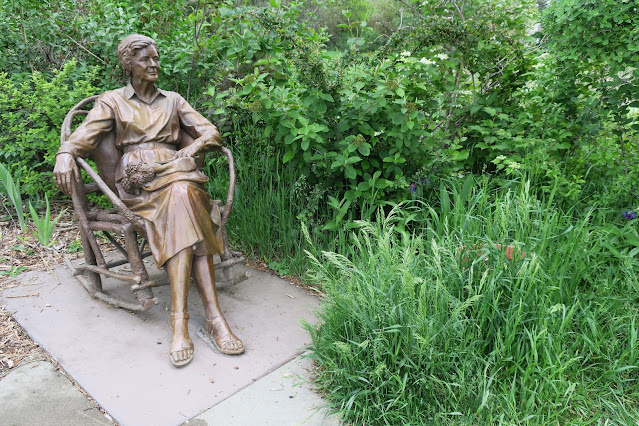
Older Woman, Benson Sculpture Garden, Colorado. May 2016

In Elderhood, author Louise Aronson draws on the salt of Ursula Le Guin: 

"There are sayings about aging that everyone likes, and others that people find reassuring when they are young or young-old, and preposterous as they grow older still. You're only as old as you think you are is one of them. 

"Ursula K. Le Guin rebutted this popular falsehood and several others with her usual wit and brilliance: 'If I'm ninety and believe I'm forty-five, I'm headed for a very bad time trying to get out of the bathtub.' 

"She goes on to note that [when people say You're only as old as you think you are to] 'somebody who actually is old, they don't realize how stupid it is, and how cruel it may be.' 

"Another expression I hear often .... is Old age isn't for sissies. Of that one, Le Guin had to say: 'Old age is for anybody who gets there. Warriors get old; sissies got old ... Old age is for the healthy, the strong, the tough, the intrepid, the sick, the weak, the cowardly, the incompetent.'

"She acknowledged that most people say such things with good intentions but equated telling her in her eighties that she wasn't old with telling the Pope he isn't Catholic. .... 'To tell me my old age doesn't exist is to tell me I don't exist.' 

"In old age, as in so many other parts of life, when our self-delusions are indulged, our reality and true selves, along with all our needs and opportunities, are erased." 

Page 141


I add another annoying bromide: Age is only a number. 

You see that on dating sites a lot. 

It makes me roll my eyes. 

I'm a woman of some age. I've clocked some numbers. I can still do a lot of shit. But there's some shit I probably can't - or don't want to - do like a thirty year-old. And there's some shit I couldn't or wouldn't do as a thirty year-old that I can do now.